Jaipur, often referred to as the "Pink City" due to the distinctive pink-hued buildings that adorn its historic core, is a mesmerizing destination that stands as a testament to India's architectural and cultural heritage. Founded with meticulous planning by Maharaja Sawai Jai Singh II in November 1727, this city embodies a unique blend of tradition and modernity. Nestled in the northern region of India, Jaipur proudly serves as the capital of the vibrant state of Rajasthan. Its status as the largest city in the state is reflective of its prominence and influence. As you explore Jaipur, you'll find a city brimming with captivating landmarks, bustling bazaars, and a rich tapestry of traditions that have been cherished for centuries. The city's pink facades, which were painted to welcome Prince Albert of England in 1876, have since become an iconic feature, infusing Jaipur's streets with a timeless charm. Each building's salmon-pink hue evokes a sense of regal elegance, making Jaipur a visual delight for all who visit.
FEATURED ARTICLE
Discover a culinary haven at RTDC Durg Cafeteria Padao, nestled within the historic Nahargarh Fort in Jaipur, Rajasthan, India. As the sun sets, immerse yourself in the magic of Jaipur's city lights, creating a mesmerizing backdrop for an unforgettable dining experience. Our open-air restaurant invites you to savor the rich flavors of both vegetarian and non-vegetarian Indian cuisine while being serenaded by live performances featuring Rajasthani folk and other talented artists. Elevate your evening with our liquor services, adding a touch of sophistication to the ambiance.
FEATURED ARTICLE
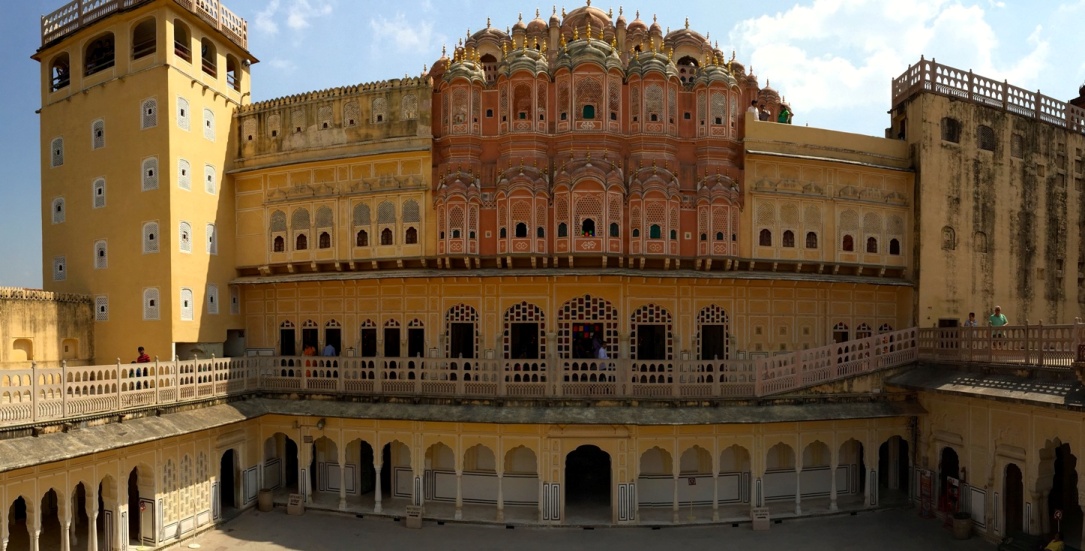
Hawa Mahal was built by Maharaja Sawai Pratap Singh in the year 1799 under the supervision of architect Lal Chand Ustad. He designed the facade of this palace like crown of his deity Lord Krishna. This 87-foot-high-pyramid-shaped, five-storied structure has 365 windows. Each storey is designated with distinct names: Sharad Mandir, Ratan Mandir, Vichitra Mandir, Prakash Mandir, and Hawa Mandir. The main entrance of the palace is known as Anandpoli and The second one is Chandrapoli. There is a huge tank with fountains in the second courtyard. To the south of this tank is Pratap Mandir, the personal room of Maharaja and Bhojanshala (kitchen) in the north. Hawa Mahal is connected to City Palace through a passage, which was used by royal females to see the Teej, Gangaur and other processions on the streets.
FEATURED ARTICLE
The Jhalana Leopard Safari or Jhalana Leopard Safari Park is India’s 1st Leopard Reserve located in Jaipur city of Rajasthan state, India. It is surrounded by Aravali hills, the oldest mountain series in India. Jhalana became a leopard reserve in 2017. The reserve is spread over an area of 20 square kilometers, with immense flora and fauna present in the park. The Jhalana Leopard Safari currently hosts more than 40 leopards and 5 cubs! Other than leopards you can spot Striped hyenas, Indian civets, desert cats, jungle cats, desert foxes, jackals, porcupines, jungle rats, monitor lizards, and mongooses, Sambar deer, spotted deer (chital), Blue Bull (Nilgai) and a variety of snakes. You also have the opportunity of visiting Shikaar Audi, the three-storeyed hunting lodge of the Royal families of Jaipur. It is located right in the middle of the leopard reserve! It has an animal-spotting platform from where you can also enjoy the sunrise and sunset.
FEATURED ARTICLE
Nahargarh fort was built by Maharaja Sawai Jai Singh II in the year 1734 for the sake of defence of Jaipur city. Originally this fort was named as Sudarshangarh, dedicating to Nahar Singh Bhomia. The fort comprises extensive Tanka and two splendid step wells for water management. Diwane-e-Aam, treasury and rest rooms for soldiers were built by Maharaja Sawai Jai Singh II (1699-1743), Hawa Mandir by Maharaja Ram Singh II (1835-1880) and Shri Madhvendhra Bhawan by Maharaja Sawai Madho Singh II (1880-1992). Nawab Wazir Ali of Awadh was given shelter here. The Man palace situated in the fort is known as Shri Madhvendra Bhawan. This double storied palace divided in ten apartments, out of which one was used by the king himself and other nine were built for his concubines. The whole palace adorned with excellent arish work and fresco paintings. The panoramic scenic surroundings of Pink City Jaipur can be viewed from the terrace of Shri Madhvendra Bhawan.
FEATURED ARTICLE
Amber Fort is situated in the valley of the Aravalli ranges just below Jaigarh Fort. Prior to shifting their capital to Jaipur, Amber was the capital of the Kachhwaha Rajputs. Amber was initially under the domain of the Susawat Meena tribe. In the 11th century, Dulahrai (Dhola), the son of Sodhadeva laid the foundation of the Kachhwaha dynasty in the Dhundhar region. His son, Kakil Dev took over the reign of Amber from the Meenas. Raja Man Singh I started the construction of the new palace complex in the end of the 16th century. After Raja Man Singh I, Mirza Raja Jai Singh I and Sawai Jai Singh II made modifications and changes as per the needs from time to time. They also changed the interior decoration as per their own interests. The entire fort was constructed in four stages.
FEATURED ARTICLE
The Government Central Museum, Albert Hall, Jaipur (1876-87) named in honour of the "Prince of Wales" Albert Edward, son of Queen Victoria who laid its foundation stone on a visit to Jaipur in 1876. It was designed by Sir Samuel Swinton Jacob (1841-1917) in the Indo-Saracenic style. Today it houses a Museum of Art and Antiquities. Egyptian Mummy, Persian Garden Carpet, etc... are displayed as the centre of attraction in the museum
FEATURED ARTICLE
Isarlat was built by Sawai Ishwari Singh in the year 1749 in commemoration of his glorious victory over the combined armies of Mewar and the Marathas, who were supporting the claim of his stepbrother Madho Singh, his rival to the throne of Jaipur. Isarlat is commonly known as Sargasuli. It is in Tripolia Bazaar between Choti Chopad and Tripolia gate. These seven storied minarets are 140 feet in height and its shape is octagonal. A flight of steps will enable us to reach the top. It is a magnificent example of architecture. Once one reaches the top of this tower, he will get a wonderful opportunity to Get a glimpse of the the whole city.
FEATURED ARTICLE
Maharaja Sawai Jai Singh (1688-1743), the founder of Jaipur, built five solar observatories at Delhi (1724), Jaipur (1728-1734), Mathura (1738), Ujjain (1734) & Banaras (1737) for observing positions of the planets above the horizon. Mughal Emperor Muhammad Shah especially appointed Sawai Jai Singh to reform the calendar and to correct the astronomical tables. After 7 year’s hard work, Sawai Jai Singh completed his tables in 1723. They were known as “Zil-i-Muhammad Shahi” These observatories are also known as Jantar-Mantar, where Jantar means instruments and Mantar means calculation. Jaipur observatory is the largest, most perfect, with greater degree of precision and best preserved among these five. The "Rashivalaya Yantra״ is found nowhere else except here. It was restored in 1901 by Maharaja Sawai Madho Singh-II in the supervision of Pt. Gokul Chandra Bhawan, Pt Chandradhar Gulari and Pt. Kedar Nath Maharaj. Restoration was done by the Then state Engineer Lieutenant Arthur Ffolliott Garrett. This monument was included in the list of world Heritage by UNESCO on 31st July 2010.
FEATURED ARTICLE
Jaipur being the hottest tourist destination in India has several enchanting spots to relish along with beautiful gardens to have a peaceful time. Vidyadhar Garden is one of the Well-conserved gardens of the city. The wonderful garden gives an immense sense of relief because of its magnificent eye-catching view. The garden was built in the first 18th century in memory of Vidyadhar Bhattacharya, the chief architect to Maharaja Sawai Jai Singh.
FEATURED ARTICLE
Sisodia Rani Bagh is a protected monument of Rajasthan Government situated in Ghat ki Guni, Jaipur. This was built by Maharaja Sawai Jai Singh in 1710 A.D. for his Chief Queen Sisodia Rani who was princess of Sisodia dynasty of Mewar, Udaipur. Apart from the lush green trees and floral beds, the beautiful Charbagh styled garden is famous for its small Palace, Multi-layered, pavilions, shrines, murals, frescoes, paintings, and fountains. The garden is equally famous among tourists and locals. Peacocks are prowling around the garden quite frequently due to its natural surroundings in hills.
FEATURED ARTICLE
Nahargarh Biological Park, a part of the Nahargarh sanctuary is located about 12 km from Jaipur on the Jaipur-Delhi highway. It encompasses a large area of 720 hectares and is situated under the Aravalli range. The Park is famous for its vast flora and fauna, and its main aim is to conserve it. It also doubles up as a great place to educate people and conduct research on existing flora and fauna. At Nahargarh Biological Park, ornithologists can expect to see over 285 species of birds, of which, the most popular is the white -naped tit, which can only be found here. When you visit the Park, make sure you also head to Ram Sagar, which is famous among bird watchers and makes for a great spot to catch different varieties of birds. You can stay at well-equipped and famous places such as Ganga Vilas, Gopal Vilas and Lalit Vilas, which were famous for the maharajas of the yore as hunting lodges. The Nahargarh Zoological Park is also worth a visit and houses animals such as Asiatic lions, Bengal tigers, panthers, hyenas, wolves, deer, crocodiles, sloth bear, Himalayan black bear, wild boar, etc.
FEATURED ARTICLE
Elephant Village is located near Kunda Amer on NH-248 in an area of 30.5 hectares. In 2017, JDA handed over Elephant Village to the Forest Department. A total of 70 elephant enclosures have been built for the residence of elephants and mahouts, out of which 68 enclosures are allotted and 2 enclosures are remaining. There are three special cottages in Elephant Village for elephants to play and stay. One large reservoir has been built in the Elephant Village for the elephants. Currently, there are 76 elephants in Jaipur.
FEATURED ARTICLE
Jaipur zoo holds a prominent place among the oldest zoos of India. This zoo is 122 years old. At the time of Independence there were zoos all over India, out of which 5 were in Rajasthan. This zoo was the biggest and best of them. Initially it extended from Ajmeri Gate to Sanganer Gate, Moti Dungri Road and Medical College. At present it is limited to two portions of land. Aviary is proposed for keeping birds in the zoo. The total area of the zoo is 5.23 hectares. The main zoo has been shifted to Nahargarh Biological Park.
FEATURED ARTICLE
Jaipur Metro Kala Deergha is situated at Chhoti Chaupar Metro Station, displaying Rajasthan’s rich archaeological artefacts, sculptures, and Ragmala paintings.
FEATURED ARTICLE
The path of Gandhi has been embraced and recognized globally. To reinforce and deepen this identity, the Gandhi Vatika has been established in Rajasthan, welcoming all who aspire to forge their own path for the future! The path of Gandhi has been embraced and recognized globally. To reinforce and deepen this identity, the Gandhi Vatika has been established in Jaipur Rajasthan, welcoming all who aspire to forge their own path for the future.
FEATURED ARTICLE
If you’re a foodie visiting Jaipur, Masala Chowk is a must-visit destination! This open-air food court in the heart of the Pink City is a one-stop spot to relish Jaipur’s best street food, all in one place. Located in Ram Niwas Garden, near the iconic Albert Hall Museum, Masala Chowk offers a delightful culinary experience with a variety of local and Indian delicacies.
FEATURED ARTICLE
Jaipur, known for its majestic forts and bustling markets, also houses some serene green spaces where nature lovers can unwind. One such hidden gem is Sawan Bhadon Park, a lush garden located within Ram Niwas Bagh. With its well-maintained lawns, vibrant flora, and peaceful ambiance, this park is a perfect retreat for morning walkers, joggers, and families looking for a tranquil escape.
FEATURED ARTICLE
Jaipur is well known for its magnificent palaces, forts, and vibrant markets, but have you ever explored its hidden desert ecosystem? Kishan Bagh is a unique and lesser-known gem in the Pink City that offers a mesmerizing blend of nature, conservation, and tranquility. Located near Nahargarh, this desert-themed park is a perfect getaway for nature lovers, photographers, and peace seekers.
FEATURED ARTICLE
In the vast spectrum of Indian Art and Heritage, the need of incubating and nurturing art and artists was prominently felt and the phenomenon brought the establishment of an international multi art and culture centre in Jaipur in 1993, popularly known as JKK. This international institution focused to the preservation and promotion of the various genres of Indian art and culture; embellishes further the visual and cultural heritage of Jaipur. In the last few of the years, JKK has apparently become the popular cultural destination and is giving a point of reference to the newly arising art and cultural centres. Owing to the activities showcased here such as workshops, dance and music recitals, theatre shows, art exhibitions and publications focused on art & culture, JKK pleasures to portray the various nuances of the genre. JKK has been constantly facilitating art-connoisseurs, scholars, artists, artisans and visitors to interact with each other through its programming. The communion and connivance has emerged to make them to observe extrinsic as well as intrinsic aspects of art and culture of Rajasthan and India. Over the years, JKK has been well perceived as the hub of arts and artistic activities and as a center for the conjunction of the classical and the folk traditions. Now, more than two decades later, it has become a pertinent centre showing great potential to cater the both i.e. Tradition and Innovation. JKK takes this opportunity to move gradually towards a more contemporary framing of the various art genres through its programs and activities.
FEATURED ARTICLE
Beed Papad Leopard Safari is situated on the north-western edge of Jaipur city at Vidhydhar nagar, a jewel within the Nahargarh Wildlife Sanctuary. Declared a protected sanctuary in 1980 and spread across 20 sq. km, it is famous for its rugged Aravalli landscapes, dry deciduous forests, and thriving wildlife. the Beed Papad leopard Safari has emerged as a premier destination for leopard sightings and eco-tourism.
FEATURED ARTICLE
VIRAT NAGAR KALA DEERGHA Book Now Rajkiya Kala Dirgha, Viratnagar, located in Jaipur district of Rajasthan, houses an important collection of archaeological and art objects discovered from the ancient site of Viratnagar (Bairat). The gallery displays sculptures, inscriptions, coins, terracotta objects, and architectural remains that reflect the cultural and historical significance of the region from ancient to early medieval periods. Viratnagar is historically associated with the Mauryan period, especially Emperor Ashoka. The Rajkiya Kala Dirgha serves as a valuable center for understanding the artistic, archaeological, and historical heritage of Rajasthan.